

The first time I flew to Phoenix to see my daughter in February, I wore a nice blouse and a thin cardigan because it was 41 degrees at home in Michigan and I assumed the plane would be, you know, indoors. It was indoors. It was also roughly the temperature of a walk-in cooler. I spent three hours and forty minutes with my arms pressed against my ribs and my cardigan stretched over my knees, and by the time I landed I had that tight, chilled, gritty feeling you get when you have been cold for too long in a small space.
I have flown to see Kate four to six times a year since then, plus a cruise and one week in Europe with Dan, and I have gotten much better at this. What follows is the routine I actually use now. It centers on one piece of gear, a maamgic shawl wrap, because a wrap does the job a cardigan cannot: it covers your arms, your shoulders, and your lap all at once, and it folds down to nothing when you do not need it. But the wrap alone is not the whole answer. The order of operations matters as much as the item.
The one thing in my tote that does the work of three
A maamgic shawl wrap measures 80 by 27 inches, so it covers shoulders, arms and lap in one move, and it packs flat enough to disappear into a personal-item bag. Rated 4.7 out of 5 across more than 8,700 reviews.
Amazon Check Today's Price on Amazon →Step 1: Dress for the plane you'll be sitting in, not the weather at either end
This is the mistake I made for years. You look at the forecast for Lansing, you see 38 degrees, and you dress for 38 degrees. Then you get to Phoenix and it is 74 and you are carrying a wool coat over your arm for six days. Or you do what I did and dress for Phoenix in February, which is to say barely at all, and freeze for the whole flight.
What works is to dress in thin layers you would be comfortable wearing in a 72-degree room, and let the wrap handle the cold part. A long-sleeve tee or a light knit under a second thin layer. Nothing bulky. No turtleneck under a sweater under a jacket, because by hour two the cabin will warm up slightly and you will be peeling layers off in a seat you cannot easily stand up from.
I pack for the destination in my suitcase. I dress for the cabin on my body. Those two things are not the same wardrobe, and once I separated them in my head, the whole packing process got easier.
Step 2: Put the wrap on before the cabin cools down, not after
Here is the thing nobody tells you. The discomfort is cumulative. If you wait until you are actually cold to put something over your shoulders, you have already spent forty minutes losing heat through your arms and neck, and getting warm again takes much longer than staying warm would have. I learned this the hard way on a red-eye out of Detroit where I kept thinking the cabin would settle and it never did.
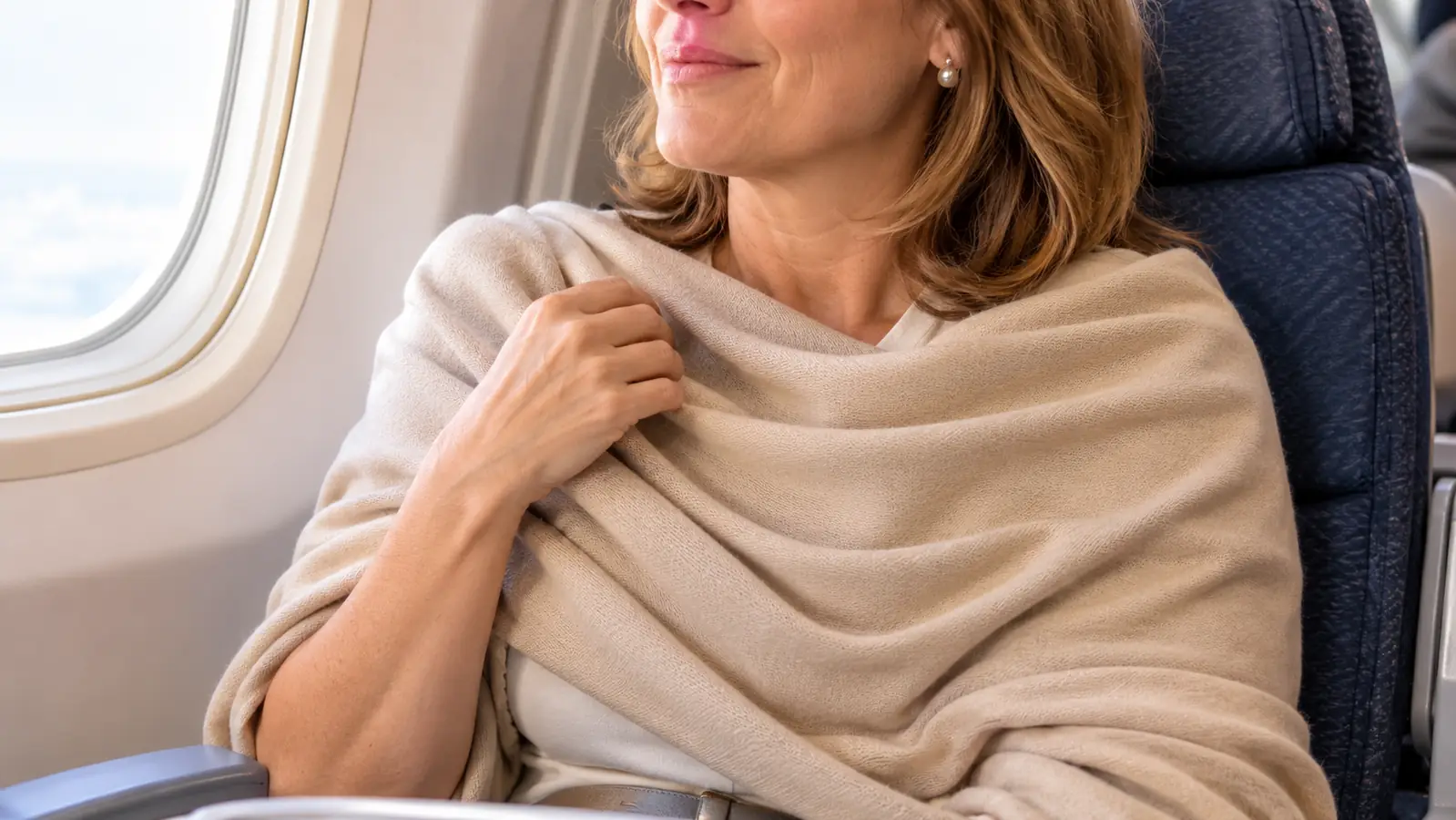
So now the sequence is: board, stow the tote, sit down, seatbelt, wrap on. Before the drink cart. Before the safety demonstration. I drape the maamgic wrap over my shoulders with the long dimension running front to back and the ends falling down over my upper arms, which leaves my hands free for a book and does not interfere with the seatbelt or the tray table.
If the cabin is genuinely warm, I do not take it off. I fold it once and let it sit in my lap, or I fold it into a long strip and tuck it behind the small of my back as a lumbar cushion, because economy seat padding and I have a long-standing disagreement. Either way it stays out. It is not going back in the bag until we are at the gate.
Step 3: Cover the two places that make the biggest difference
Shoulders and thighs. Those are the two areas where cold really gets into me on a plane, and they are the two areas a cardigan does not help with at all. My shoulders get cold because the cabin air comes down from above and lands right there. My thighs get cold because I am sitting still for three or four hours and thin trousers plus a plastic seat is not a warm combination.
The wrap solves both because of its size. At 80 inches long and 27 inches wide, it is long enough to drape from my shoulders down across my lap and still have slack, which is the entire reason I stopped using a regular scarf for this. A scarf covers your neck. A wrap covers your neck, your shoulders, your arms, and your legs. There is no comparison on a cold flight.
I also wear thick socks, not thin ones, and I put them on before I get on the plane rather than changing in the seat. The floor of an airplane is cold and my feet are the first thing to go. This is not glamorous advice but it is the advice I would give a friend.
One more note on the wrap itself: it is a lightweight polyester and cotton blend, medium stretch, machine washable. That combination matters more than it sounds. A heavy wool wrap is warmer in a drafty room, but it is also bulkier in a bag and it is a nuisance to care for on the road. I have washed mine in a hotel sink with a bar of soap, rolled it in a towel, and hung it over a chair back overnight. It was dry by morning. That is the kind of thing that makes a piece of clothing actually usable when you travel, as opposed to theoretically nice.
At 80 inches long and 27 inches wide, the wrap is long enough to drape from my shoulders down across my lap and still have slack, which is the whole reason I stopped using a regular scarf for this.
Step 4: Make it look intentional once you land
I am 54 and I have reached the stage where I would like to get off a plane looking like a person, not like someone who has been napping in a bus shelter. A fleece blanket does not do that for you. A wrap does, if you handle it right.
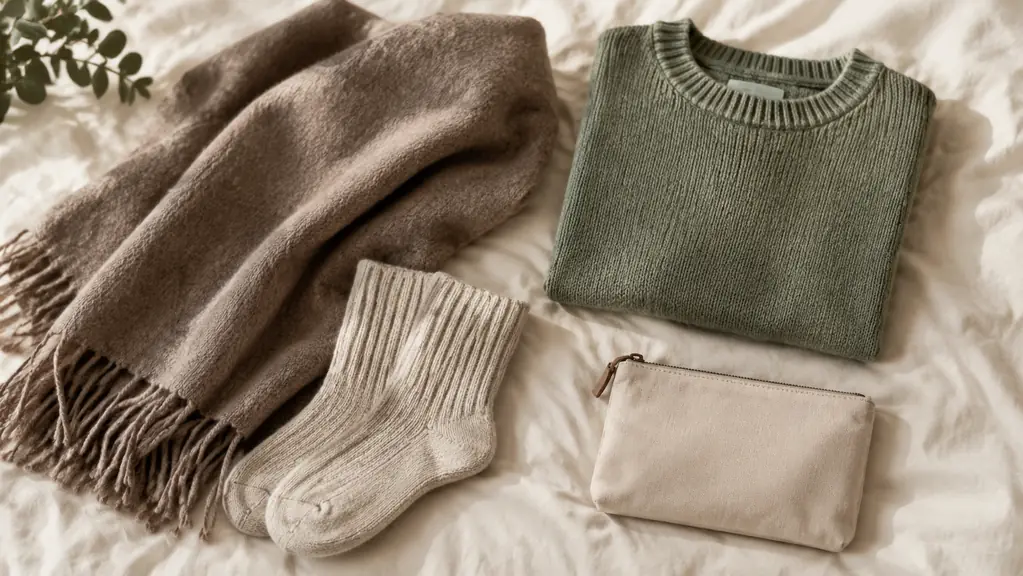
When we start our descent, I take it off my shoulders and rearrange it. Two useful options. First, folded in half lengthwise and draped over both shoulders with the ends hanging down in front, held at the collarbone with a pin or just tucked, which reads as a shawl over a blouse or a light knit. Second, folded into a triangle and worn over one shoulder with the point in front, which is a bit more dressed-up and works well if you are going straight from the airport to dinner.
The thing that makes this work is that the maamgic wrap is a solid, simple piece with clean edges. It is not a novelty print and it is not a travel gadget, so it does not announce itself as airplane equipment. It is just a wrap. That is the whole point. It goes from a cold cabin to a restaurant without a costume change.
I also use it during the trip, which is worth mentioning because it changes how you think about the packing math. It is a shoulder cover for a chilly restaurant. It is a lap blanket on a cruise deck in the evening. It is a layer for a stone church in Europe where the inside temperature has apparently not changed since 1400. One item doing four jobs is how you get away with one carry-on.
Step 5: Pack it so it is available, not buried
This sounds trivial and it is not. If the wrap is at the bottom of your roller, you will not use it, because you are not going to stand up in a cramped cabin and dig through a suitcase to get it. It needs to live in your personal-item tote, on top, easy to grab with one hand.
I fold mine into a rectangle roughly the size of a hardback book, roll it once more so it holds the shape, and put it in the tote between my book and my little pouch of cords. It takes up about as much room as a paperback. When I get to my seat, I pull it out, and the tote goes under the seat in front of me. No standing up, no reaching overhead, no asking a stranger to move.
One caution. Do not fold it into the same tight crease every single time for months on end, or that crease will set. I alternate where I fold it, and I hang it over the back of a chair for an hour once I am at Kate's place. It has held up well; the fabric is a light polyester and cotton blend and it has not pilled in the wash.
What Else Helps
The wrap does most of the work, but a few small things make a real difference and they cost you almost no space. A pair of thick socks, as I mentioned, is the highest-value item in this entire routine per ounce of luggage. A small refillable water bottle keeps you hydrated, and hydration is a big part of why you feel wrung out after a flight, though it will not stop you being cold.
Ask for the blanket anyway. It is thin and it is not clean, but layering it over your lap on top of the wrap on a long flight is a meaningful improvement, and there is no reason not to. On a full flight, ask early, before they run out.
Choose your seat with the cold in mind if you can. Window seats are colder because of the wall, and exit rows are frequently colder because of the door. If you are someone who is always cold, a middle or aisle seat a few rows back is usually a slightly better bet, and the aisle seat also means you can stand up and move around, which helps more than people realize.
Finally, wear your heaviest layer onto the plane and do not pack it. This is basic but it took me years to actually do it. The thing you would most regret carrying is the thing you should be wearing at the gate.
If you want a closer look at how the wrap has held up over multiple trips, I wrote about that separately, and I also compared it against a travel blanket scarf for anyone trying to decide between the two. For the shorter version, the maamgic shawl wrap has replaced both a cardigan and a lap blanket in my bag, and after a couple of years of flights to Phoenix I have stopped looking for anything else.
The item I now pack before I pack anything else
Soft polyester and cotton blend, medium stretch, machine washable, 80 by 27 inches, and it folds down to about the size of a paperback. If you are always cold on planes, start here.
Amazon Check Today's Price on Amazon →