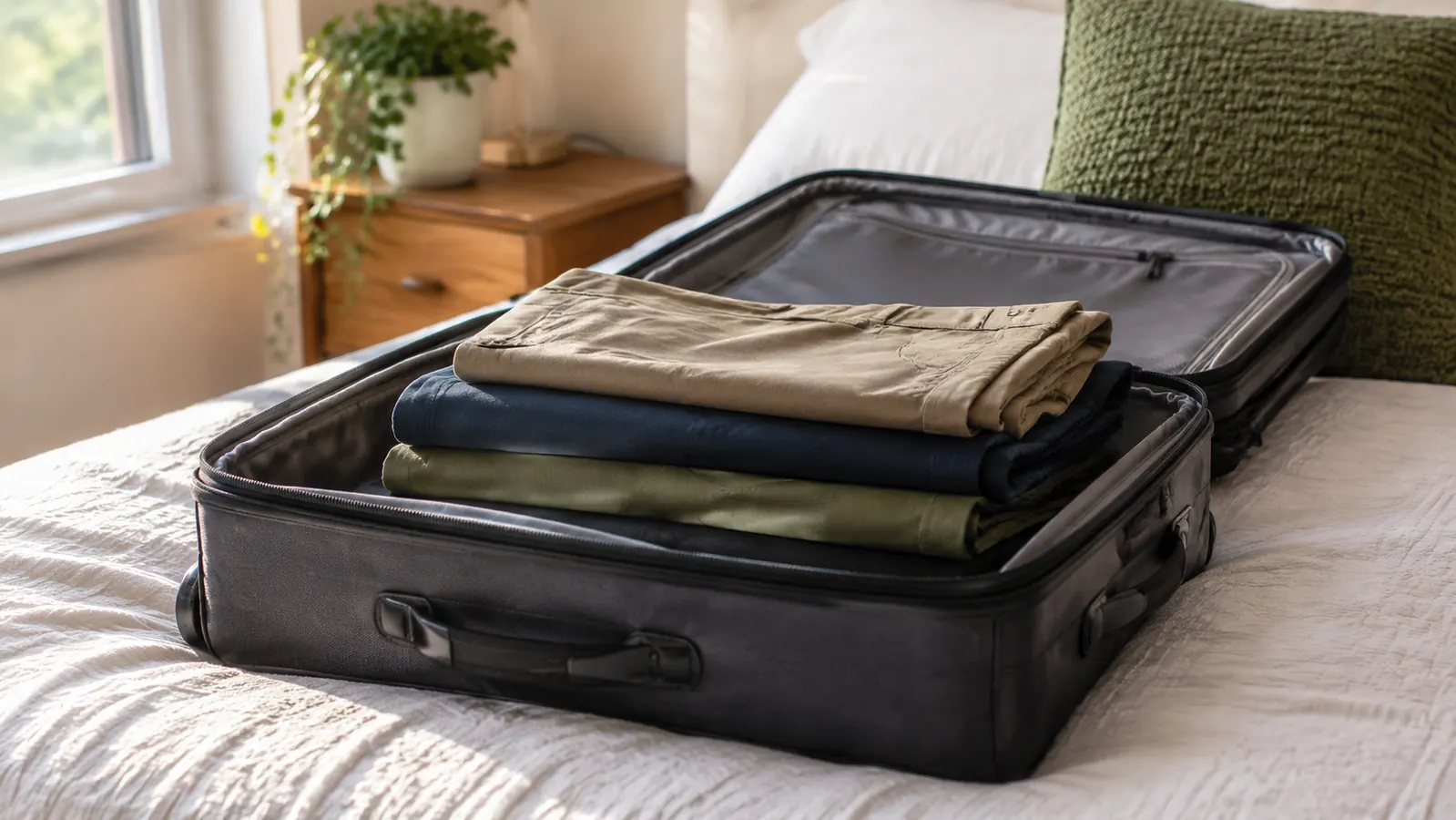
Three pairs of pants, one soft-sided carry-on, five days in Phoenix. I have run that math more times than I can count, and for years the answer came back the same: a stack of creases across the front of the thigh that made it look like I had slept in them. Which, by the time I landed, I nearly had. For a long time I blamed the pants. I bought stiffer ones, thinner ones, a pair that cost more than my first car payment, and every one of them came out of the bag looking tired. The pants were not the problem. The way I was putting them into the bag was.
Here is what I finally worked out after a decade of four to six trips a year, half of them carry-on only. Wrinkle-free pants get you most of the way there, and the Lee Women's Wrinkle Free Relaxed Fit Straight Leg Pant is the pair I keep coming back to after trying the alternatives. The rest is folding, packing order, and ten minutes of attention when you get to the room. None of it requires special equipment, none of it requires a steamer in your luggage, and all of it fits inside a bag that goes in the overhead bin.
The pants I build the rest of the suitcase around
Relaxed fit, straight leg, ankle length, flat front, and seven ounces of fabric that folds flat instead of fighting you. This is the pair everything else in the bag gets planned around.
Amazon Check Today's Price on Amazon →The Five Steps, In Order
Step 1: Start With Pants That Are Already Doing the Work
You cannot fold a pair of linen trousers into a carry-on and expect them to come out smooth, and no folding method will save a fabric that creases if you look at it wrong. Fabric does most of the work before you ever open the suitcase. A wrinkle-free finish means the fibers were treated to relax back toward flat after they are compressed, which is why a treated pair survives a week in a bag while a plain cotton twill does not. It is also why the pair you choose matters more than the folding method you use on it.
The Lee pair I travel with is a relaxed fit with a straight leg that ends at the ankle. That combination is quietly good for packing. A narrow leg has to be folded tight, and a tight fold becomes a crease. A relaxed straight leg folds into a wide, shallow stack that matches the footprint of a carry-on instead of being squeezed into a hard line down the middle of the leg. Mid rise, flat front, zipper closure, four pockets, and seven ounces on my kitchen scale. Light fabric folds smaller and presses less on itself.
One more thing before you fold anything: empty all four pockets. A wallet left in a back pocket leaves a dent in the fabric that no hanger will take out, and a boarding pass you discover in Phoenix is a boarding pass you did not need. Lay the pants out on the bed and run your hands over them. Check the hem for a loose thread, check the knees for whatever you leaned against at the airport, and check that the zipper is closed. Fifteen seconds, and it prevents the two most common arrival problems.
Step 2: Fold Along the Leg, Not Across It
Most people fold pants the way they fold a bath towel, in half across the middle. That puts a single hard crease straight through the seat, which is the worst possible place for one, and it doubles the thickness of the bundle at the same time. The thicker the bundle, the more pressure the layers put on each other, and pressure is what turns a fold into a crease that stays. Fold along the leg instead, and you trade one deep crease for two shallow ones in places a crease belongs.
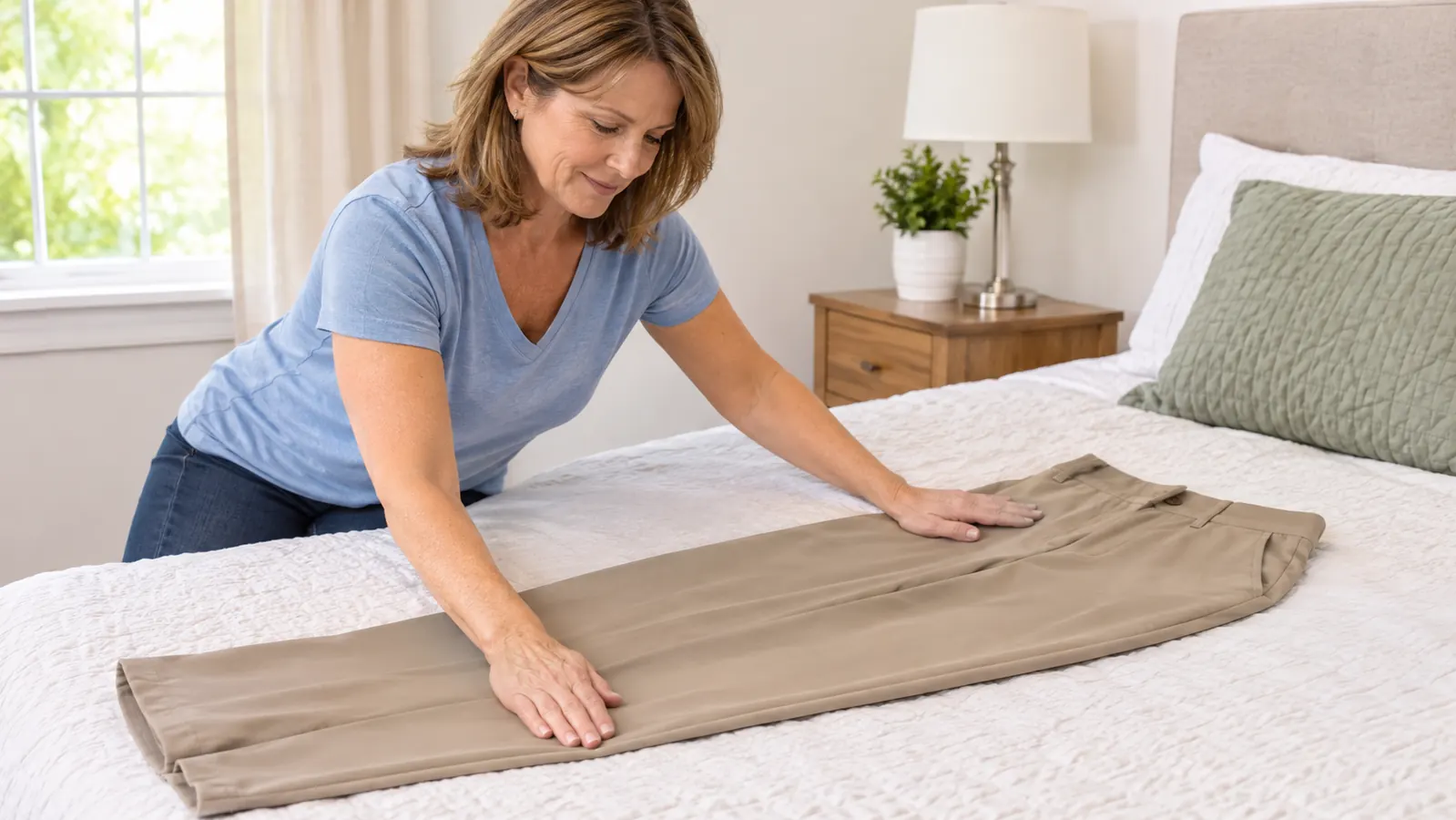
Lay the pants flat, match the waistband corners together, and stack the legs seam to seam. Smooth them with your palm from waistband to hem so there is no trapped air and no fabric folded back on itself. Then fold in thirds rather than halves. Bring the hem up to just below the knee, then bring that bundle up to the waistband. You end up with a short, wide rectangle roughly the size of a hardback book, with shallow folds at the knee and the middle of the thigh and nothing sharp anywhere.
The fold down the front of each leg is unavoidable, and it is fine, because it lands where a pressed crease would sit anyway. What you are avoiding is a fold across the lap and a fold across the back of the knee. Ankle length pants help here, since the whole bundle is shorter and there are fewer layers of fabric stacked on top of each other by the time you are done. Fewer layers, less weight, fewer creases. That is the whole equation.
Step 3: Pack Flat and Let the Bag Do the Pressing
Pants go in near the top of the stack, not at the bottom. The bottom of a carry-on is where the shoes and the hair dryer live, and weight is what sets a crease. Lay the folded bundle flat across the width of the bag so it spans the whole footprint rather than sitting in one corner, then put only soft, light things above it. Sleep shirt, the pouch of socks and underwear, a scarf. Nothing with a corner, nothing with a heel, nothing that weighs more than a paperback.
The other half of this is not overpacking. A carry-on that has to be zipped with effort is a carry-on pressing your clothes flat under tension for six hours, and a hotel hanger cannot undo six hours. If you are kneeling on the bag to close it, you have already lost. I pack to about eighty percent full and use the compression strap to take up the slack. If the bag is still tight, something comes out, and it is usually the second pair of shoes.
Skip the rolling. Rolling works for t-shirts and it works for a soft duffel where nothing has an edge. On a straight leg pant it simply multiplies the folds. Roll a pair of pants and you get a spiral of creases running the whole length of the leg, and a spiral is the hardest shape to hang out once you arrive. I know this because I did it for years and then wondered why my pants looked like they had been wrung out.
A carry-on that has to be zipped with effort is a carry-on pressing your clothes flat under tension for six hours.
Step 4: Add a Slip Layer, Not More Stuff
A thin dry cleaner bag is the oldest item on this list and it still works. Slip each folded pair into one, or lay a sheet of tissue paper between the folds. The bag lets the layers slide instead of grip. When the contents of the suitcase shift in transit, and they always shift, the pants do not rub against each other. Friction is half of what makes a crease permanent, and the plastic costs nothing because it comes home with your dry cleaning anyway.
Tissue paper does the same job for less space. Crumple a sheet, smooth it out, and lay it over the fabric before each fold so it sits inside the crease rather than beside it. Do not use newspaper, because ink transfers and it transfers worst on light fabric. Do not use a scented dryer sheet either, unless you want your pants to smell like a candle for the first three days of the trip and then like a candle and coffee.
One caution about the lid. The zippered compartment in the top of a carry-on is tempting for pants because it looks flat, but it is the first thing that gets squeezed when the bag goes in the overhead bin. Put the pants in the main body of the case and put the things you do not care about in the lid. Socks are flexible. Pants are not.
Step 5: Handle the First Twenty Minutes in the Room
Unpack before you do anything else. Not after dinner, not after you check your phone, not after you lie down for ten minutes that turn into an hour. Pants that come out of the bag and go straight onto a hanger have a full night to relax. Pants that stay in the bag until morning keep every fold they picked up in the overhead bin, and by then the fabric has been under pressure for eighteen hours. The first twenty minutes do more than the next eight hours.
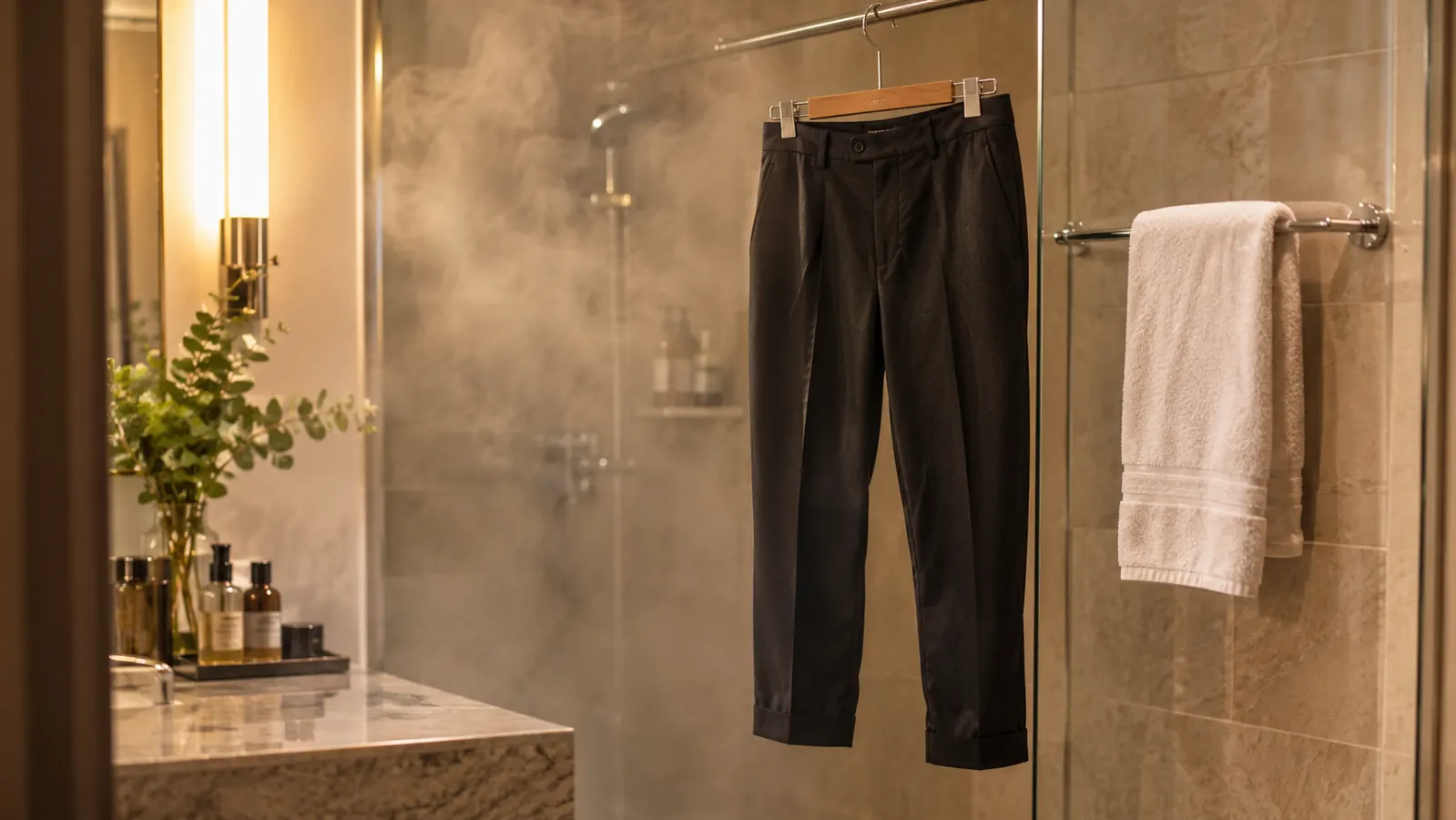
Hang them by the hem from a clip hanger when the hotel gives you one. Gravity pulling down the length of the leg does more than gravity pulling from the waistband. Then run the shower hot for five minutes, close the bathroom door, and leave the pants hanging where the steam reaches them but the water does not. The wrinkle-free finish needs heat and a little moisture to relax back toward flat, and a hotel bathroom provides both for free. It is the least glamorous spa treatment in the building and it works.
If the air is dry or the creases are stubborn, spritz the fabric with plain water, hold it taut with your free hand, and pass the hair dryer over it on warm from about a foot away. Keep the dryer moving so you are heating the fabric and not scorching it. Two minutes of that will handle anything a week in a suitcase can produce, including the crease across the lap that you swore was permanent.
What Else Helps
Wear the bulkiest pair on the plane. That is not a compromise, it is the strategy. Two pairs of Lee pants folded in the bag plus the pair on your legs gets you through a week with laundry optional, and the pair on your body arrives smooth because it has been hanging in your closet for a month. Wear the shoes that take up the most room for the same reason. Nobody at the gate is grading you on how many pairs you packed.
Pack shoes in cloth bags so the heels are not grinding against fabric for six hours, and keep the small heavy things, chargers, toiletries, the hair dryer, in a separate pouch at the top of the bag so they never press down on the pants. Choose a solid rather than a busy pattern if you want creases to be less obvious. Keep a thin folding hanger in the bag, because hotels rarely have enough and the ones they do have are usually bolted to the rod.
Three pairs is the right number for a week: one on the plane, two in the bag. Wash nothing, or wash one and hang it overnight in the bathroom with the fan on. Lee pants dry quickly and they do not need the hotel laundry, which is a line item I object to on principle. If your trip runs longer than a week, plan a laundry stop rather than packing a fourth pair. Four pairs is not a carry-on anymore, it is a checked bag with extra steps.
Pack the pair that comes out of the bag ready to wear
Relaxed fit, straight leg, ankle length, flat front, four pockets, seven ounces. Fold it in thirds, lay it flat, hang it by the hem when you land. That is the entire method.
Amazon Check Today's Price on Amazon →