
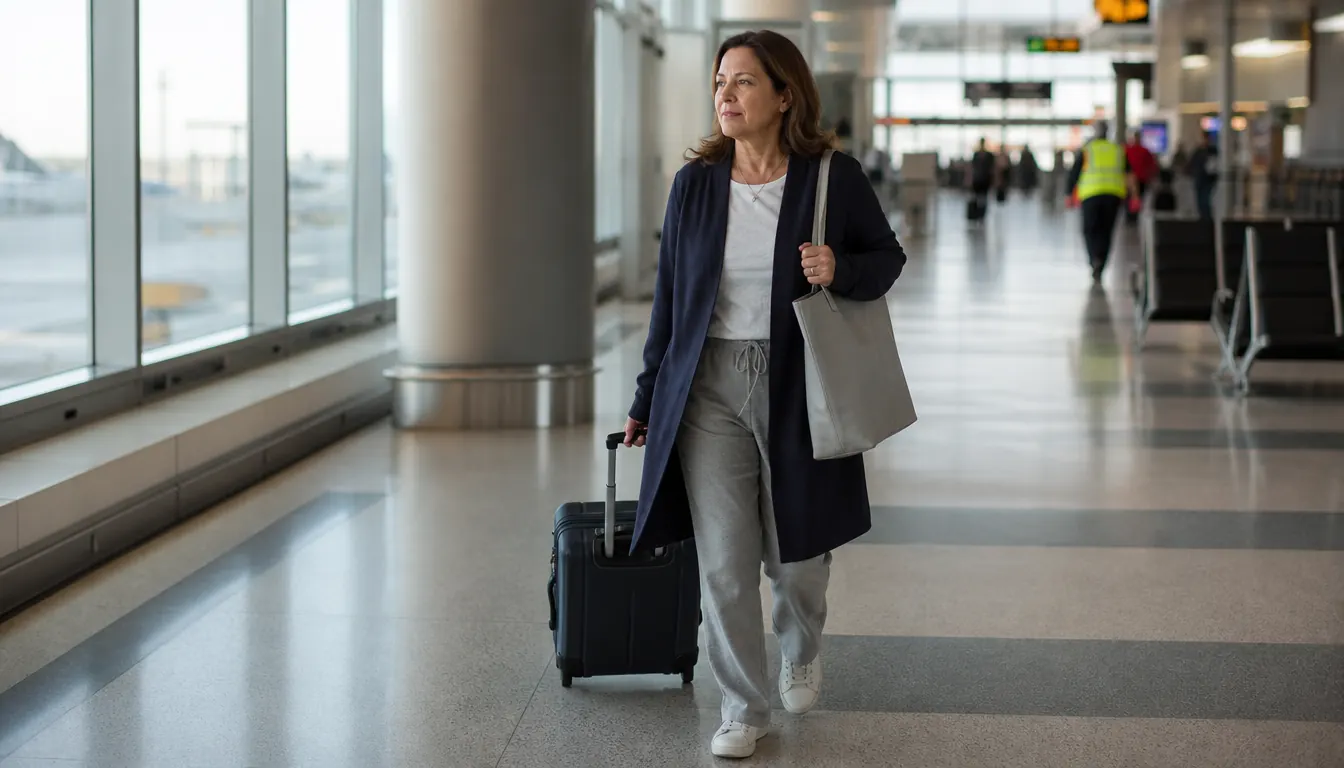
I bought my first pair of compression socks the way a lot of women in their fifties do. Somebody at a family dinner mentioned that her doctor had told her to start wearing them, and I nodded, and I filed it away for two years. What finally moved me was a four-hour flight to Phoenix to see my daughter, middle seat, no aisle access, and by the time we landed my ankles had that tight warm swollen feeling I had been pretending not to notice since my late forties. I ordered the CHARMKING compression socks three-pack the following week, mostly because the listing carried more than ninety thousand reviews and the odds seemed decent. That was several trips ago. They live in the front pocket of my carry-on now, and I do not board a plane without a pair.
This is not a medical review. I am not a nurse, though I spent thirty years in a dental office on my feet and I know what leg fatigue feels like by four in the afternoon. What follows is a plain account of how these socks held up across roughly a dozen trips: carry-on flights to Arizona, two long drives around the Great Lakes with my husband Dan, and one bigger trip a year. What I liked, what annoyed me, and who I think should actually spend the money.
The Quick Verdict
A quietly effective travel sock with real graduated squeeze and a three-pair pack that makes laundry math work on the road. The single size range is the one thing that will trip some people up.
Amazon Check Today's Price →The pair that lives in my carry-on pocket now
Three pairs of CHARMKING compression socks, 15-20 mmHg, machine washable, and light enough that you will not notice them in a packed roller bag. This is the exact pack I have been replacing pair by pair for the last several years.
Amazon Check Today's Price on Amazon →How I've Used It
My travel is not glamorous. Four to six times a year I fly carry-on only to Phoenix, which means one soft-sided roller and one tote and nothing else. That flight runs anywhere from three and a half hours to five depending on the connection. Twice a year Dan and I drive the Great Lakes loop, eight or nine hours a day in the car with the seat pushed back and the vents pointed at my knees. Once a year we do something bigger, a cruise or a week in Europe, and that is where the genuinely long travel day shows up.
The thing I figured out is that the soreness is not really about the flight. It is about the sitting. On the Phoenix run I put the socks on at the gate, before boarding, because wrestling a tight sock onto my own foot in a middle seat with someone's elbow in my ribs is not an experience I care to repeat. On the road trips I put them on before we pull out of the driveway and take them off at the first hotel. That is the whole routine. No ritual, no timing tricks.
The first pair lasted about a year and a half of that before the elastic at the top started to feel less like a hug and more like a suggestion. I noticed it on the drive home from Traverse City in October, somewhere north of Cadillac, when I realized I had been tugging at the top edge for the last forty miles without thinking about it. I replaced that pair and kept the other two going, which is how a three-pack quietly stretches into two years of use if you are not careful about laundry. The two replacements have behaved exactly the same way, which tells me the first one was not a fluke and roughly eighteen months of steady use is what I should expect from a pair.
What 15-20 mmHg Actually Feels Like in Row 22
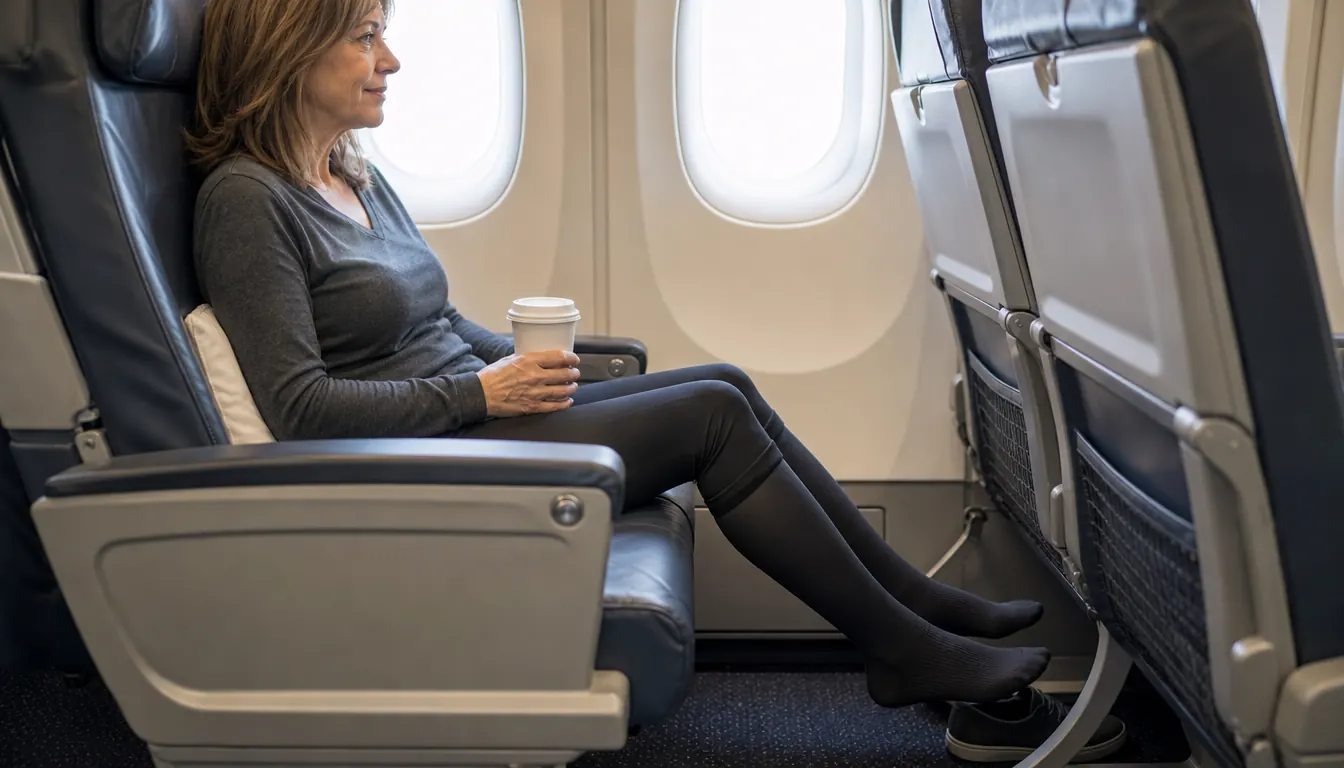
The number on the label means graduated compression, which is a plain way of saying the squeeze is firmest at the ankle and eases as it climbs. Fifteen to twenty is the mild end of the range, the end people wear for travel and long standing shifts rather than the end a doctor hands you after surgery. It is not a gentle sock. The first time I put one on I had to work it up from the heel in stages, and I remember standing in my bedroom thinking I had bought the wrong thing entirely.
Twenty minutes later I forgot about it. That is the test I use now. If I stop noticing a sock within the first half hour, it is doing its job quietly. These do. By the time we were somewhere over Missouri my calves felt neutral instead of heavy, and when I stood up at the gate in Phoenix my ankles looked like ankles. On the return leg, which is always the harder one, I have started paying attention to the five hour mark, and the calf still feels normal while my feet are the part that complains. That is the opposite of how a flight used to end for me. The first summer I wore them I made the mistake of judging by the first hour, when the sock just feels tight and strange, and concluding they were not worth the trouble. The first hour is not the test. The fourth is.
The flip side is that they are not a lounging sock. If I leave them on past the point where I am up and moving, say through a whole evening at Kate's apartment, the top edge starts to leave a mark and my toes feel crowded. Off after the flight. On again the next morning if there is another flight. That is how I have settled into using them, and it has worked far better than trying to wear them from breakfast to bedtime.
Why Three Pairs Turned Out to Be the Right Number
I would have bought one pair if one pair had been on offer. Three turned out to be correct, for a boring reason. A compression sock needs washing between wears, it takes longer to air dry than a regular sock because of how dense the knit is, and hotel sinks are not a reliable laundry facility. With three in the CHARMKING pack I can hand wash one in the evening, pack two, and still have a clean pair for the flight home. On the February trip I washed a pair in Kate's bathroom sink with a bar of soap, rolled it in a towel, and hung it over the shower rod, and it was dry by the next afternoon. One pair would have meant doing that every single night or packing a damp sock, and neither of those is a vacation.
The fabric is 85 percent nylon and 15 percent spandex, which is why they dry reasonably fast and why they come back into shape after a wash instead of going baggy at the calf. The care instructions say machine wash, and I have machine washed mine, cold, in a mesh bag, then hung them over the shower rod. I have not put them in the dryer. I am not willing to find out what happens.
The one place the pack frustrated me is that the socks are a solid pattern, so there is nothing to tell them apart in the wash. I have started marking the toe of one pair with a laundry pen. Small thing. It matters at six in the morning when you are trying to find two matching socks in a hotel room with the curtains still closed.
The Drugstore Pair I Tried First
Before I ordered these I bought a single pair off a drugstore rack on the way to the airport, the kind sold in a cardboard sleeve next to the foot powder. It was thin, it slid on easily, and it felt like nothing. That was the problem. By the second hour of the flight the squeeze had faded to the point where I could not tell I was wearing it, and by the time we landed my ankles were exactly as puffy as they are without any sock at all.
The difference with the CHARMKING socks is not subtle. They are denser, they grip the foot from the arch up, and the compression is still there at hour four instead of hour one. The trade is that they are harder to get on, and there is no way around that. A sock that goes on easily is a sock that is not compressing much.
Washing, Pulling On, and the Small Friction
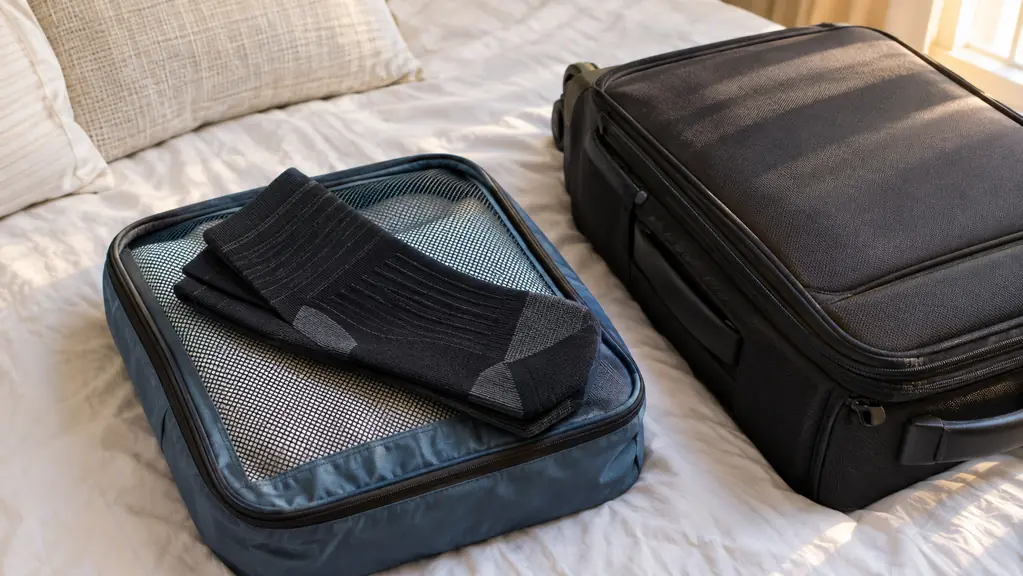
There is no zipper, no clasp, no strap to adjust. The closure is pull-on and that is the entire mechanism, which I have come to appreciate. Nothing to break, nothing to forget at home, nothing to explain at a security checkpoint. The way I put one on is to sit on the edge of the bed, bunch the sock down to the heel, work it over the toes and the ball of the foot, then walk it up the calf a few inches at a time with both hands. Standing and yanking does not work, and yanking is how I put a thumbnail through the first pair of compression socks I ever owned.
The size range is the real limitation. These come in Large-X-Large, one range for everybody, and that is going to work beautifully for some women and not at all for others. I am five foot four and hovering around a hundred and fifty pounds and they fit me with a little room at the toe. A friend of mine who is taller with heavier calves tried a pair and found the top edge tight enough to be distracting. If you are at either far end of the size spectrum, buy one pack and test it on a short trip before you commit it to a ten-hour travel day.
The pack is listed at 6.4 ounces, which is close to nothing in a carry-on, and the socks fold flat enough to slide into the lid pocket of my roller. Compared to the space a neck pillow eats, they are essentially free. That matters when you are the person who refuses to check a bag.
Where They Fell Short
The honest complaints are three, and none of them are dealbreakers for me. The single size range is the biggest one, and I have already said my piece about it. The second is that 15-20 mmHg is the mild end of the scale, so if your doctor has told you to wear 20-30, these are not that, and no amount of tugging will make them that. Buy the level you were told to buy.
The third is the top edge on a long day. On a five-hour flight with a connection, by hour six I can feel exactly where the sock ends. It is not painful, it is just present, the way a watch band is present. Taking them off when the travel day is over solves it entirely, which is why I stopped trying to wear them from morning to night.
What I Liked
- The 15-20 mmHg squeeze is still doing something at hour four, not just at hour one
- Three pairs make hand washing on the road practical instead of a nightly chore
- Machine washable, cold, and they come back into shape instead of going slack
- Folds flat and weighs almost nothing in a carry-on only setup
- No zipper or clasp to fail, which matters on a sock you travel with for years
Where It Falls Short
- One size range, Large-X-Large, so fit is a gamble at either end of the spectrum
- Only the mild 15-20 mmHg level, not a substitute for a prescribed 20-30
- The top edge becomes noticeable on travel days longer than about six hours
- Solid pattern with nothing to tell the three pairs apart in the laundry
By the time we were somewhere over Missouri my calves felt neutral instead of heavy, and when I stood up at the gate in Phoenix my ankles looked like ankles.
Who This Is For
If you are a woman in your forties, fifties, or sixties who flies a handful of times a year and has started noticing that your ankles and calves are unhappy by the end of a travel day, this is the pair I would hand you. It is also the pair I would hand a first-timer, because 15-20 mmHg is mild enough to get used to over a couple of trips without feeling like you have strapped something medical to your legs. The CHARMKING pack is what I recommend to friends who ask, and two of them now own it.
It also suits anyone who spends a full day on their feet, and anyone doing a long driving day where the seat does the damage. I have recommended them to a retired teacher who does eight-hour drives to see her grandchildren, and she reports the same thing I do, which is that the difference shows up after the trip, not during it.
Who Should Skip It
Skip these if a doctor has specified 20-30 mmHg or higher. That is a different garment and buying the wrong level is worse than buying nothing. Skip them if your calves run very small or very large, because one size range cannot serve everybody and you will fight the top edge either way. And skip them if the idea of working a tight sock over your heel every morning makes you tired just reading about it, because that part does not get easier with practice.
If you want a print, a stripe, or something that looks like a fashion accessory rather than a solid travel sock, this is not that either. These are plain and they read as plain. I have decided I do not care, since nobody at a gate has ever looked at my ankles, but you should know what you are getting before you order.
Do the laundry math once and you stop thinking about it
Three pairs, 15-20 mmHg graduated compression, machine washable, and flat enough to disappear into a carry-on lid pocket. The pack I have been rotating for years, replaced one pair at a time.
Amazon Check Today's Price on Amazon →